
What Is a Service Attribution Method?
Published: 1 September 2026
Introduction
A service attribution method determines what portion of the projected retirement benefit is considered to have accrued by the reporting date. Under Japanese GAAP, companies must choose either the Straight-Line Attribution Method or the Benefit Formula Attribution Method. Once a method has been adopted, it is generally required to be applied consistently on an ongoing basis. It is therefore important to fully understand the characteristics and key considerations associated with each method.
This article introduces the available attribution methods and describes how they are used in calculating Defined Benefit Obligations under Japanese GAAP. It is the first article in a series that will go on to look at how the choice of attribution method impacts the Defined Benefit Obligation (DBO) and how the impact can vary for different types of plan.
Contents
- What Is a Service Attribution Method?
- Straight-Line Attribution Method
- Benefit Formula Attribution Method
- 3.1 Benefit Formula Attribution Method for Point-Based and Cash Balance Plans
- 3.2 Materially Back-Loaded Benefit Accruals
1. What Is a Service Attribution Method?
To calculate the DBO, the total retirement benefit expected to be paid at retirement is first estimated. The portion of that benefit considered to have accrued, or been built up, by the reporting date is then determined (this is the role of the service attribution method). That accrued portion is then discounted to calculate the DBO. The two choices of service attribution method under Japanese GAAP are described below.
Straight-Line Attribution Method:
A method under which the projected retirement benefit is allocated evenly across the employee's entire service period, with an equal portion recognised as accruing in each period.
Benefit Formula Attribution Method:
A method under which the projected retirement benefit is allocated in accordance with the plan's benefit calculation formula, with the amount attributed to each period reflecting the benefit accrued during that period.
Note that under the Benefit Formula Attribution Method, if a materially higher level of benefit accrues in later years of service than in earlier years, the benefit formula must be adjusted to reflect an even accrual of benefits over the relevant period.
2. Straight-Line Attribution Method
The Straight-Line Attribution Method is a method under which the projected retirement benefit is allocated evenly across the employee's entire service period.
The process for calculating the DBO using the Straight-Line Attribution Method can be illustrated in the following three steps.
DBO Calculation Process (Straight-Line Attribution Method)
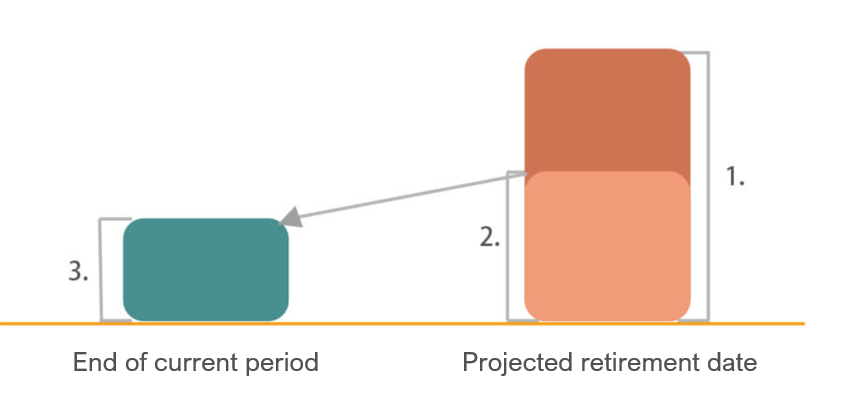
- Estimate the future retirement benefit cash flows (the projected retirement benefits) based on when employees are expected to leave the plan, taking into account factors such as employee turnover, expected salary increases and benefit payment provisions.
- Multiply the amount calculated in Step 1 by the proportion of total service completed to determine the portion of benefits considered to have accrued by the reporting date.
- Discount the amount calculated in Step 2 using the discount rate to calculate the DBO at the reporting date.
When considering the total service to use in your calculation for the Straight-Line Attribution Method, the Actuarial Practice Guidance on Retirement Benefit Accounting (published by the Institute of Pension Actuaries of Japan and the Institute of Actuaries of Japan) highlights the following issue:
Accounting standards do not define or explain the term "total service period." While it can be interpreted as the period from an employee's date of hire to their expected retirement date, it may also be interpreted as the period used as the basis for calculating retirement benefits. Under the latter interpretation, periods such as those listed below would generally not be considered part of the total service period.
Examples of periods that would generally not be included in the total service period are:
- Any probationary period that is not taken into account when calculating retirement benefits.
- Any waiting period before joining the retirement benefit plan, where that waiting period is not taken into account when calculating retirement benefits.
- Any period of service before the retirement benefit plan was established, where that service is not taken into account when calculating retirement benefits.
- Any period of service after reaching a specified age, where service beyond that age is not taken into account when calculating retirement benefits.
- Any period of service after a specified date, where that service is not taken into account when calculating retirement benefits, for example because all future benefit accruals have been transferred to a defined contribution pension plan.
3. Benefit Formula Attribution Method
The Benefit Formula Attribution Method is a method under which the projected retirement benefit is allocated in accordance with the plan's benefit calculation formula, with the amount attributed to each period reflecting the benefit accrued during that period.
The process for calculating the DBO using the Benefit Formula Attribution Method can be illustrated in the following three steps. Unlike the Straight-Line Attribution Method, a key feature of this approach is that, in Step 1, the amount attributed to service up to the reporting date is determined directly from the plan's benefit calculation formula.
DBO Calculation Process (Benefit Formula Attribution Method)
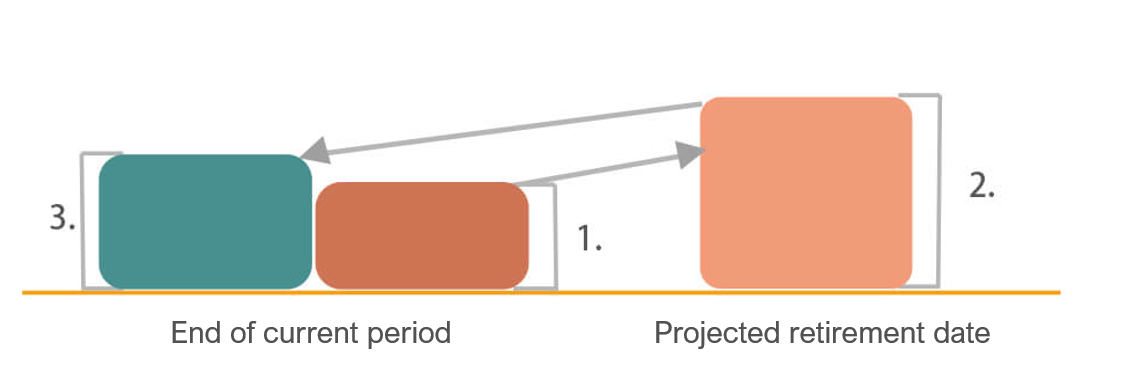
- Determine the amount of benefit built up based on service up to the reporting date in accordance with the plan's benefit calculation formula.
- Calculate the associated cash flows, taking into account factors such as employee turnover, expected salary increases and benefit payment provisions.
- Discount the amount calculated in Step 2 using the discount rate to calculate the DBO at the reporting date.
Where the Benefit Formula Attribution Method is used, if the benefits determined under the plan's benefit calculation formula are materially higher in the later years of service than in the earlier years, Japanese GAAP stipulates the benefit formula must be adjusted by deeming benefits to accrue evenly over the relevant period.
Situations in which this requirement applies are referred to as "materially back-loaded benefit accruals", and the adjustment made in such cases is referred to as a "leveling adjustment."
3.1 Benefit Formula Attribution Method for Point-Based and Cash Balance Plans
For Point-Based and Cash Balance plans, the Actuarial Practice Guidance on Retirement Benefit Accounting describes two approaches that may be used under the Benefit Formula Attribution Method. The first approach involves treating the plan as one in which benefits are proportional to average points (or average contribution credits). The second approach involves treating each year's points (or contribution credits) as attributable solely to that year - without allowing for future point accumulations (or future contribution credits). These methods are described below.
"Method 1" - Treating the plan as one in which benefits are proportional to average points (points based plans) or average contribution credits (cash balance plans)
- Treat the point-plan benefit formula as average points multiplied by service to date (where the average points are calculated as the total expected cumulative points at retirement, divided by the total expected service up to retirement). Then, using this benefit formula, determine the amount of benefit built up based on service up to the reporting date.
- Calculate the associated cash flows, taking into account factors such as employee turnover, expected salary increases and benefit payment provisions.
(Note: Expected salary increases are reflected in the calculation.) - Discount the amount calculated in Step 2 using the discount rate to calculate the DBO at the reporting date.
With respect to Step 1, the above applies to point-based plans. For Cash Balance plans, the approach is as follows:
Treat the Cash Balance benefit formula as the average contribution credits multiplied by the service to date (where the average contribution credits are calculated as the hypothetical account balance, including revaluation, divided by the total expected service up to retirement). Then, using this benefit formula, determine the amount of benefit built up based on service up to the reporting date.
Variations of this approach allow averages to be taken over specific periods rather than the entire expected service period to retirement. For example, if points stop accruing at a certain age, the averaging period may stop at that age. Examples of these situations will be covered in later articles.
In some instances, the results by Method 1 will be the same as those produced under the Straight-Line Attribution Method.
"Method 2" - Treating each year's points (or contribution credits) as attributable solely to that year - without allowing for future point accumulations (or future contribution credits)
- Treat the points awarded in each period as constituting the benefits attributed to that period. Accordingly, future point awards are not reflected in the DBO calculation. The amount attributed to service up to the reporting date is then determined in accordance with the plan's benefit calculation formula.
- Calculate the associated cash flows, taking into account factors such as employee turnover and benefit payment provisions. Because future point awards are not reflected, expected salary increases are not incorporated into the calculation.
- Discount the amount calculated above using the discount rate to calculate the DBO at the reporting date.
With respect to the first two steps, the above applies to point-based plans. For Cash Balance plans, the approach is as follows:
- Treat contribution credits awarded in each period as constituting the benefits attributed to that period. Accordingly, future contribution credits are not reflected in the DBO calculation. The amount attributed to service up to the reporting date is then determined in accordance with the plan's benefit calculation formula.
- Calculate the associated cash flows, taking into account factors such as employee turnover and benefit payment provisions. Because future contribution credits are not reflected, expected salary increases are not incorporated into the calculation. However, expected future revaluations (i.e. the assumed revaluation rate) are reflected.
As mentioned before, where future point accumulations or future contribution credits are considered to be materially back-loaded, a leveling adjustment is required. Method 2 is not compatible with such an adjustment. Accordingly, the adoption of Method 1 should be considered.
3.2 Materially Back-Loaded Benefit Accruals
Regarding the criteria for determining whether benefits are materially back-loaded, the Implementation Guidance on Accounting Standards for Retirement Benefits states the following in its Basis for Conclusions:
Where benefits determined in accordance with a benefit formula are materially back-loaded, the back-loaded portion of those benefits must be attributed evenly over the relevant service period.
However, international accounting standards do not prescribe specific criteria for determining when benefits calculated in accordance with a benefit formula should be regarded as materially back-loaded. During the deliberation process, consideration was given to whether more detailed guidance should be included in the Implementation Guidance. However, it was concluded that specifying such guidance could potentially reduce consistency with international accounting standards, and therefore no such guidance was provided.
Accordingly, when determining whether benefits attributed under the Benefit Formula Attribution Method are materially back-loaded, it is necessary to consider the specific facts and circumstances on a case by case basis.
In the next article we will bring to life both the Straight Line and Benefit Formula Attribution Methods by showing how their adoption impacts the DBO.