
How the Choice of Service Attribution Method Affects the Defined Benefit Obligation - Part 1
Published: 10 September 2026
Translation of our original Japanese article dated 19 September 2014
In this article, we build on the concepts introduced in our previous article on service attribution methods. Using examples, we will illustrate the impact of each method on the Defined Benefit Obligation (DBO).
If you have not read our introductory article, or would simply like a refresher, it can be found here.
Contents
- Service Attribution Method Options under Japanese GAAP
- Key Concepts Behind Each Service Attribution Method
- Final Salary-Based Plans
1. Service Attribution Method Options under Japanese GAAP
In 2012, revisions were made to the Japanese GAAP accounting standard. One of these changes was the introduction of the Benefit Formula Attribution Method as a prescribed option. Previously, the only default approach set out in the guidance was the Straight-Line Attribution Method. Therefore, it was adopted by most companies. Since the revision, some companies have adopted the Benefit Formula Attribution Method, while others have continued to use the Straight-Line Attribution Method.
Many people, including those new to using Japanese GAAP, may not understand the differences between the two methods and therefore which method is best for their situation.
In the examples that follow, we will look at several scenarios illustrating the impact on the DBO of using either the Straight-Line Attribution Method or the Benefit Formula Attribution Method.
2. Key Concepts Behind Each Service Attribution Method
A Reminder of the Thinking Behind Each Service Attribution Method
Straight-Line Attribution Method:
A method under which the projected retirement benefit is allocated evenly across the employee's entire service period, with an equal amount attributed to each period.
Benefit Formula Attribution Method:
A method under which the projected retirement benefit is allocated in accordance with the plan's benefit calculation formula, with the amount attributed to each period reflecting the benefit accrued during that period.
These descriptions may be a little difficult to follow so let's take a more practical look at how these methods can be interpreted in practice.
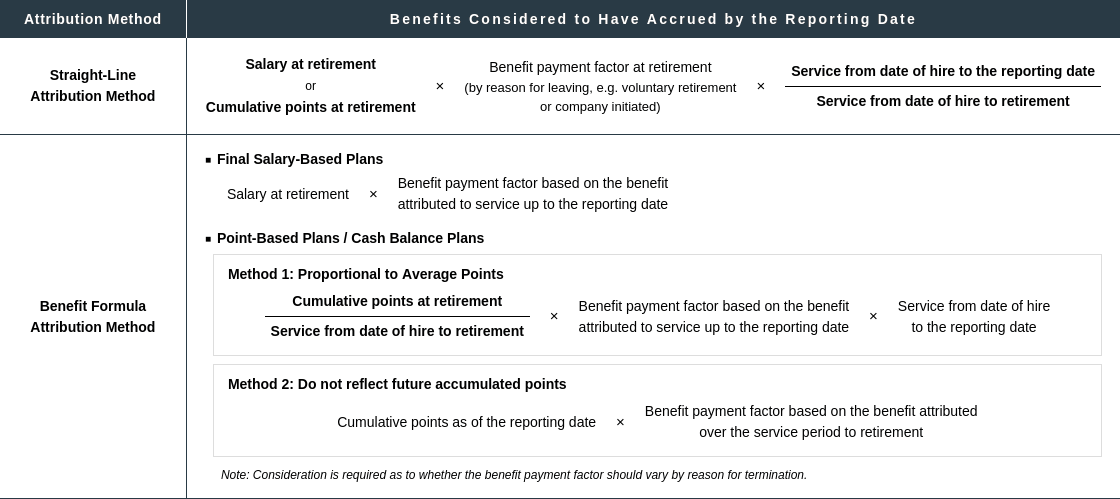
To understand the specific impact of each attribution method (i.e. whether it results in a higher or lower DBO), it is probably easiest to look at each case individually.
3. Final Salary-Based Plans
Retirement Benefit = Reference Salary × Benefit Multiplier
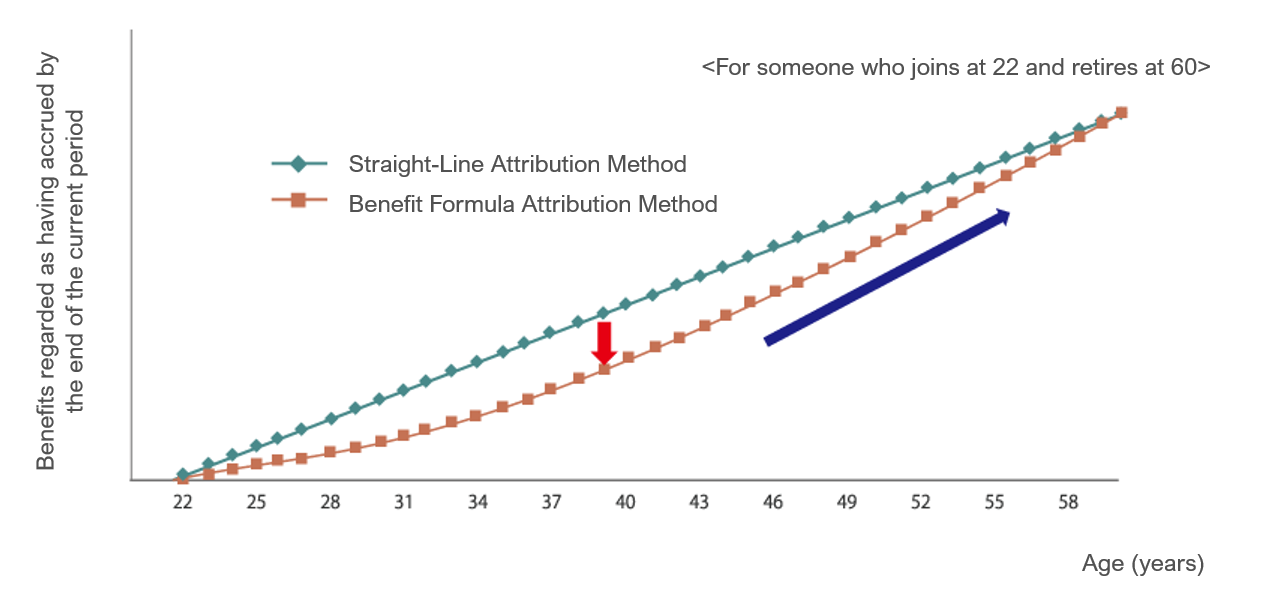
Case 1: Where the Benefit Multiplier Follows a Concave-Up Benefit Accrual Curve Throughout the Service Period
Key Points
- Under the Straight-Line Attribution Method, the projected retirement benefit is recognised evenly over the employee's service period. As illustrated above, benefits are therefore attributed in a straight line.
- Under the Benefit Formula Attribution Method, expense is recognised in line with the increase in the benefit multiplier in each period. Accordingly, benefits are attributed in accordance with the shape of the benefit multiplier curve shown above.
- Therefore, in this case, using the Benefit Formula Attribution Method instead of the Straight-Line Attribution Method results in a lower DBO for all employees.
For example, for an employee who is currently age 40, the difference between the DBO calculated using the Benefit Formula Attribution Method and that calculated using the Straight-Line Attribution Method is shown by the red arrow above (i.e. a lower DBO).
When Japanese GAAP was revised and companies switched from using the Straight-Line Attribution Method to the Benefit Formula Attribution Method, those with a benefit formula similar to that shown above saw an immediate reduction in the DBO (with the change being reflected through an adjustment to retained earnings).
In this example, the DBO decreases (and retained earnings increase). However, where does the impact of that reduction in the DBO ultimately appear?
Over the long term (i.e. from an employee's date of hire through to retirement), the total amount of expense recognised under the Straight-Line Attribution Method and the Benefit Formula Attribution Method is the same.
Accordingly, where the DBO decreases as in this example, the total expense recognised in future periods will increase by a corresponding amount.
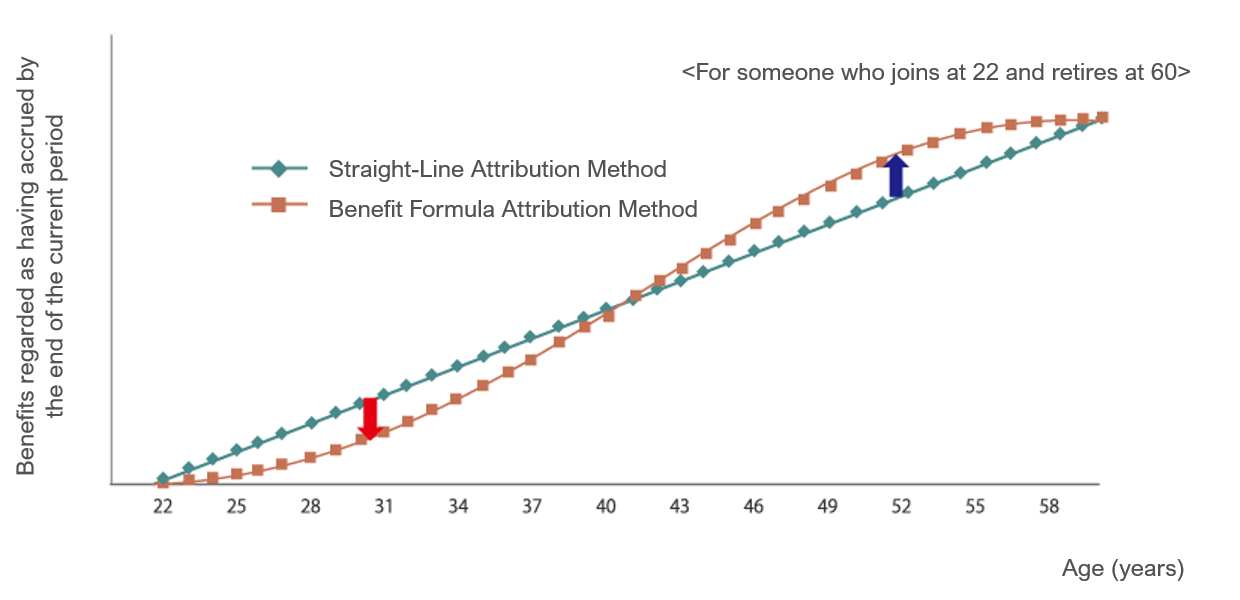
Case 2: When the Benefit Accrual Rate Follows an S-Shaped Benefit Curve
Key Points
- As in the previous example, under the Benefit Formula Attribution Method, expense is recognised in line with the increase in the benefit multiplier in each period. Accordingly, benefits are attributed in accordance with the S-shaped benefit multiplier curve shown above.
- Therefore, in this case, using the Benefit Formula Attribution Method instead of the Straight-Line Attribution Method results in a lower DBO for younger employees (red arrow) and a higher DBO for older employees (blue arrow).
In this scenario, the overall impact on the company's DBO, whether it is higher or lower, will depend on the age distribution of its employees.
In the next article, we will look at examples involving Point-Based plans and Cash Balance plans.
Please note that this article also includes the personal views of the consultant who authored it.
This article is a translation of one written in 2014, shortly after the updates to Japanese GAAP were required to be considered by companies for their year-ends. Adjustments have been made to the wording to shift the focus from switching methods (which was common at the time as the Benefit Formula Attribution Method had just been introduced and companies were able to consider it for the first time) to illustrating the differences between the methods.