
How the Choice of Service Attribution Method Affects the Defined Benefit Obligation - Part 3
Published: 1 October 2026
Translation of our original Japanese article dated 9 March 2015
This article is the latest in our series explaining service attribution methods and how they impact DBO calculations.
Earlier articles introduced the concept and applied it to Final Salary schemes and to Point-Based and Cash Balance Plans.
You can read them here:
In this article we shift our attention to plans with materially back-loaded benefit accrual. Through a series of examples, we will consider leveling adjustments used under Japanese GAAP and explain their impact on the Defined Benefit Obligation (DBO).
Contents
- Materially Back-Loaded Benefit Accruals
- Leveling Adjustments
1. Materially Back-Loaded Benefit Accruals
When applying the Benefit Formula Attribution Method, the guidance states that:
"If the benefits determined under the benefit formula are materially back-loaded, the materially back-loaded portion of those benefits must be attributed evenly over the relevant service period."
But what types of situations are considered "materially back-loaded"?
The accounting standards do not provide any specific examples.
Translated from the Implementation Guidance on Accounting Standards for Retirement Benefits:
International accounting standards do not specifically prescribe the circumstances in which benefits determined in accordance with a benefit formula should be regarded as materially back-loaded.
During the deliberation process, consideration was given to whether more specific guidance should be included in the Implementation Guidance. However, it was concluded that prescribing such guidance could potentially reduce consistency with international accounting standards. Accordingly, no such guidance was provided.
As a result, determining whether benefits under a particular benefit formula are materially back-loaded requires consideration of the specific facts and circumstances of each case.
Most retirement benefit plans are likely to have benefit formulas that are back-loaded to some extent.
However, whether a plan should be regarded as materially back-loaded must be assessed based on its particular circumstances.
Accordingly, the company, its external auditor, and the actuarial service provider responsible for the DBO calculation should review the plan in advance and determine whether it should be classified as materially back-loaded. If it is, a leveling adjustment (discussed in the following section) must be applied.
2. Leveling Adjustments
In this section we use the following example where benefits arise only in the later years of service (provided the eligibility conditions are met).
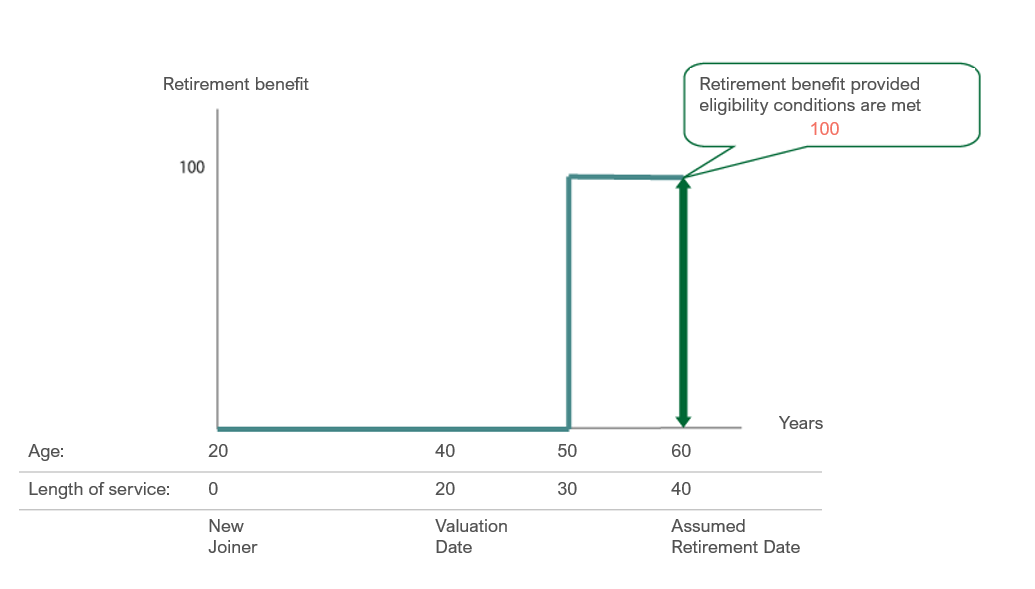
Consider a plan under which a retirement benefit of 100 is payable if the employee retires at age 50 or later.
Under the assumptions below, how would the amount of benefit regarded as having accrued by the reporting date be measured under each service attribution method?
Assumptions
- Joined the company at age 20
- Current age at the reporting date: 40 (20 years of service)
- Retirement age: 60 (40 years of service)
(1) Straight-Line Attribution Method
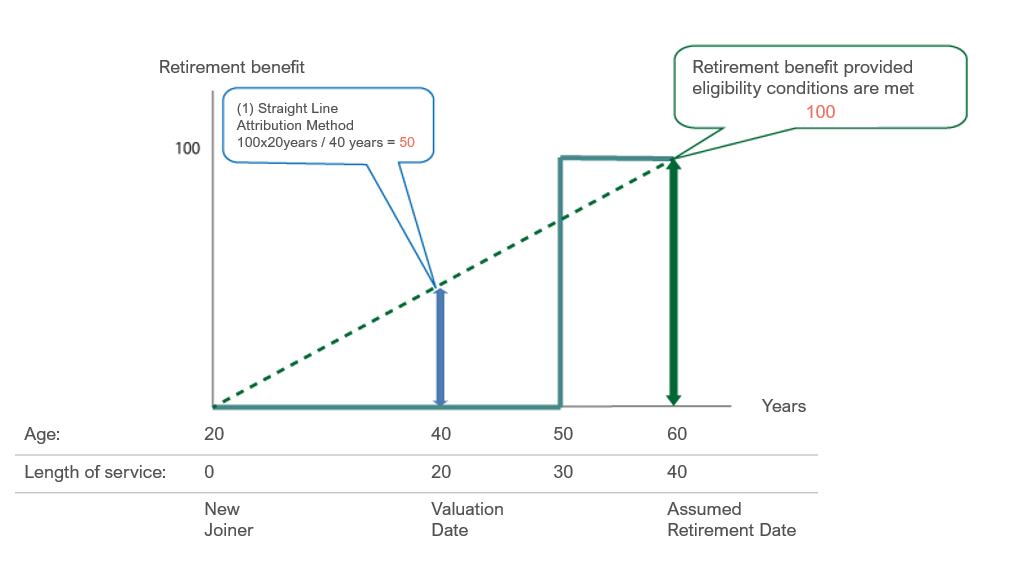
Under the Straight-Line Attribution Method, the retirement benefit of 100 payable at retirement is attributed evenly over the period from the employee's date of hire to retirement (as shown by the green dotted line in the diagram).
Therefore, the accrual is calculated as follows:
Benefit considered to have accrued by the reporting date = 100 × 20 years / 40 years = 50
Thus, the benefit regarded as having accrued by the reporting date is 50.
In addition, the amount of benefit attributed to each year of service (from the date of hire through to retirement) is a constant 2.5 per year (= 100 / 40 years).
(2) Benefit Formula Attribution Method (With No Leveling Adjustment)
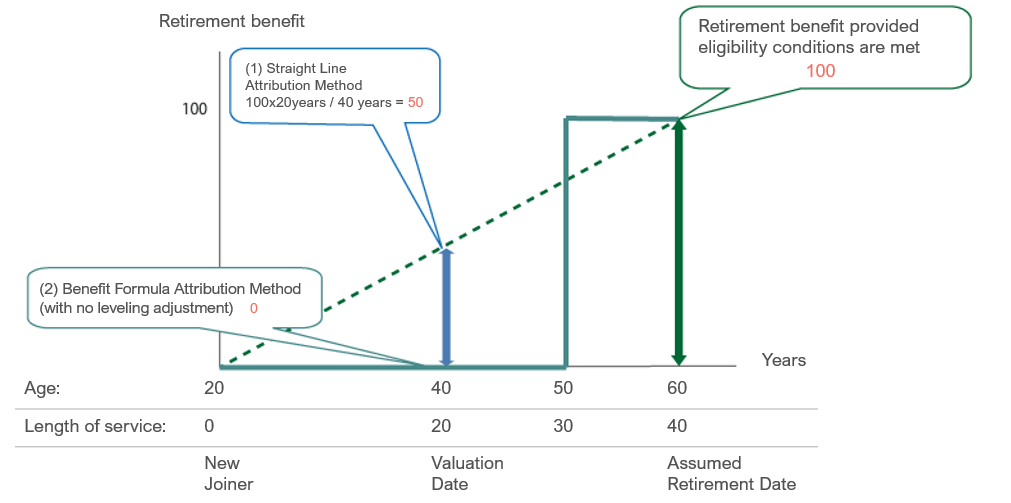
Under the Benefit Formula Attribution Method (with no leveling adjustment), benefits are attributed in accordance with the benefit formula (following the solid turquoise line in the chart).
Therefore, the accrual calculation is simply:
Benefit considered to have accrued by the reporting date = 0
i.e. no benefit is regarded as having accrued by the reporting date.
Under this approach, the entire benefit of 100 would be attributed to the year in which the employee reaches age 50, while no benefit would be attributed to any other year of service.
Therefore, it is difficult to argue that this approach results in the retirement benefit being attributed to each period of service on a reasonable basis.
(3) Benefit Formula Attribution Method (With a Leveling Adjustment)
In a retirement benefit arrangement like this, how should a leveling adjustment be applied?
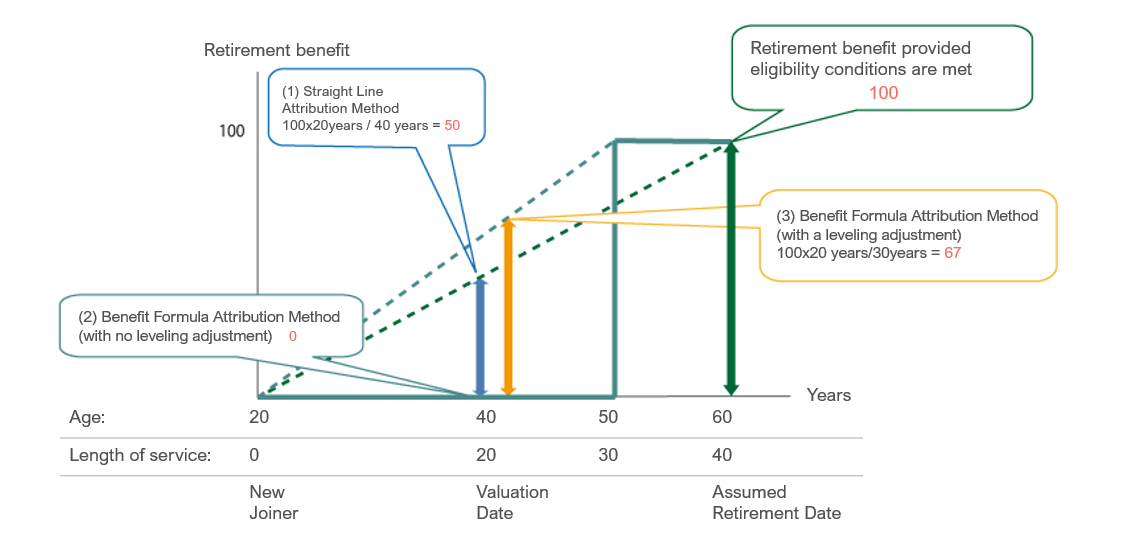
Because the plan is designed such that a retirement benefit of 100 becomes payable once the employee reaches age 50, one possible approach is to apply a leveling adjustment over the period from the employee's date of hire until reaching age 50 (as shown by the new dotted line on the chart).
Therefore, in this case, the accrual is calculated as follows:
Benefit considered to have accrued by the reporting date = 100 × 20 years / 30 years = 67
Thus, the benefit regarded as having accrued by the reporting date is 67.
In addition, the amount of benefit attributed to each year of service (from the date of hire until reaching age 50) is a constant 3.3 per year (= 100 / 30 years).
If the retirement benefit payable at age 50 is viewed as a reward for the employee's service up to that point, then this method of attributing benefits to periods of service may be considered reasonable.
Please note that some of the views expressed in this column represent the personal opinions of the authoring consultant.