
How the Choice of Service Attribution Method Affects the Defined Benefit Obligation - Part 2
Published: 18 September 2026
Translation of our original Japanese article dated 27 October 2014
This article is the latest in our series explaining service attribution methods and how they impact Defined Benefit Obligation (DBO) calculations.
As a reminder, in our first article we introduced the concept of service attribution methods.
You can read this here.
In our second article we used a Final Salary scheme as an example to illustrate how the choice of method impacts the DBO.
You can read this here.
In this installment, we focus on Point-Based Plans and Cash Balance Plans.
Contents
- Simplified Benefit Formulas
- Method 1: Proportional to Average Points
- Method 2: Do Not Reflect Future Accumulated Points
- Impact on the DBO
Simplified Benefit Formulas
To begin, the following simplified definitions are used throughout this article:
Point-Based Plan Benefit
= Cumulative Points Earned × Point Value × Payment Factor (Based on Reason for Leaving)
Cash Balance Plan Benefit
= Hypothetical Account Balance (= Cumulative Contribution Credits + Cumulative Interest Credits) × Payment Factor (Based on Reason for Leaving)
As mentioned in our previous article, for Point-Based and Cash Balance plans, the following two approaches are recognised under the Benefit Formula Attribution Method.
Method 1: Proportional to Average Points
Under this approach, the benefit formula for a point-based plan is equivalent to a formula based on average points multiplied by years of service to date (where average points are calculated as the cumulative points earned divided by the total service). The benefit formula attribution method is then applied by treating the plan as one in which benefits are determined in proportion to average points earned over an employee's service period.
Note that the period used to calculate the average points can be tailored to the specific plan. As you will see in future examples, it can be adjusted to allow for points stopping accruing at a certain age.
Method 2: Do Not Reflect Future Accumulated Points
Under this approach, the points awarded in each period are attributed solely to that period. Accordingly, points that will be awarded in future periods are not reflected in the DBO calculation.
For Cash Balance plans, however, future revaluations of benefits based on the assumed revaluation rate are included in the DBO calculation.
Impact on the DBO
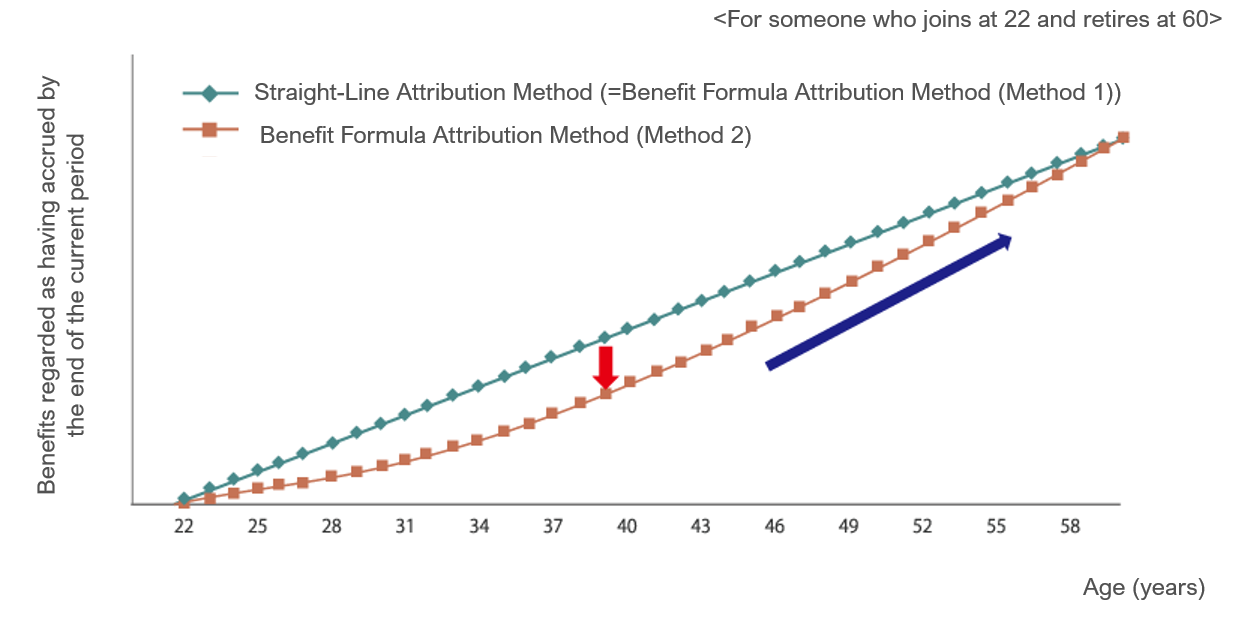
Case 3: When Cumulative Points Follow an Upward-Curving Benefit Pattern Throughout the Service Period
Key Points
- Under the Straight-Line Attribution Method, the projected retirement benefit is attributed evenly across the employee's service period. As shown in the chart above, benefit accrual therefore follows a straight-line pattern.
- Under Method 1, the attribution pattern is the same as under the Straight-Line Attribution Method for this plan. (Note that depending on the shape of the benefit accrual curve, however, the two approaches may not always produce identical results.)
- In contrast, under Method 2, the points awarded in each period are attributed to that specific period. In other words, the benefit regarded as having accrued by the end of a reporting period is equal to the cumulative points earned as of that date. As a result, benefit attribution follows the shape of the cumulative points accrual curve shown above.
- Accordingly, in this example, using Method 2 results in a lower DBO than using the Straight-Line Attribution Method for all employees.
As discussed in Part 1, over the long term (i.e. from an employee's date of hire through to retirement), the total amount of expense recognised under either the straight line or benefit formula attribution methods is the same.
In simple terms, this means that opting for the method that gives a lower DBO today will result in a higher P&L impact over future periods as the retirement benefit expense is recognised.
Conversely, using a method that gives a higher DBO today will result in a lower P&L impact over future periods.
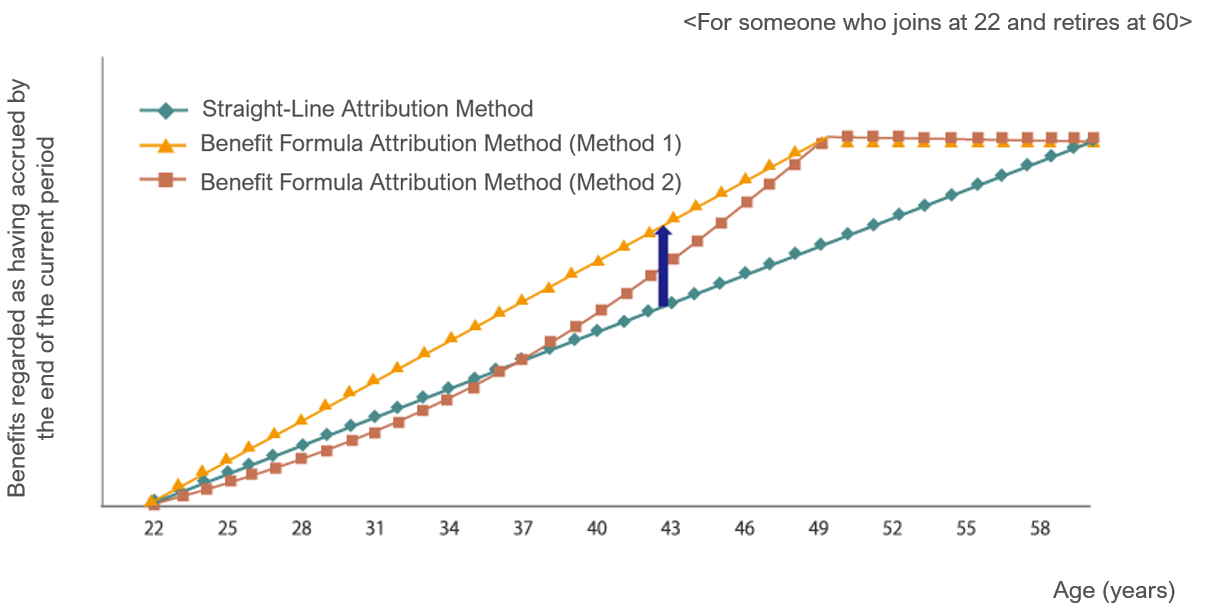
Case 4: When Points Cease to be Awarded at a Specified Age (or After a Specified Length of Service)
Key Points
- Under the Straight-Line Attribution Method, benefits are attributed on a straight-line basis, as illustrated in the chart above.
- Under Method 2, benefit attribution follows the shape of the cumulative points accrual curve shown above.
- Under Method 1, if it is assumed that no further benefit attribution occurs after point awards cease, benefits are attributed on a straight-line basis over the period up to age 50, as illustrated above.
- Accordingly, Method 1 results in a higher DBO for all employees.
- By contrast, Method 2 results in a lower DBO than the Straight-Line Attribution Method for younger employees but a higher DBO for older employees.
- For employees aged 50 or above (i.e., those for whom point awards have already ceased), the DBO calculated under Method 1 is the same as that calculated under Method 2.
In the next installment, we will examine other important considerations to keep in mind when selecting a service attribution method.
Please note that some of the views expressed in this column represent the personal opinions of the authoring consultant.
This article is a translation of one written in 2014, shortly after the updates to Japanese GAAP were required to be considered by companies for their year-ends. Adjustments have been made to the wording to shift the focus from switching methods (which was common at the time as the Benefit Formula Attribution Method had just been introduced and companies were able to consider it for the first time) to illustrating the differences between the methods.