
Attribution Methods Under Other Accounting Standards
Published: 13 October 2026
In this final article in our series, we turn our attention to the attribution methods required under IFRS and US GAAP and compare them to those available under Japanese GAAP.
While the terminology differs between accounting standards, many of the underlying concepts are similar. In the following sections, we briefly review the methods available under Japanese GAAP before introducing the approaches used under IFRS and US GAAP.
If you missed the earlier articles in this series, which introduce service attribution methods under Japanese GAAP and show how they are applied, you can read them here:
Contents
- Japanese GAAP (Recap)
- IFRS
- US GAAP
- Conclusion
1. Japanese GAAP (Recap)
As discussed throughout this series, Japanese GAAP allows companies to choose between two service attribution methods:
- The Straight-Line Attribution Method
- The Benefit Formula Attribution Method
Under the Straight-Line Attribution Method, projected retirement benefits are attributed evenly over an employee's service period. Under the Benefit Formula Attribution Method, projected retirement benefits are attributed in accordance with the plan's benefit formula.
Where benefits determined under the benefit formula are judged to be materially back-loaded, an adjustment is required to attribute part of the benefit evenly over the relevant service period.
As we will see below, the Benefit Formula Attribution Method shares many similarities with the approaches required under IFRS and US GAAP.
2. IFRS
IFRS (IAS 19) requires the Projected Unit Credit Method (PUCM) to be used. Under this approach, each period of service creates an additional unit of benefit entitlement. These are measured separately to build up the final obligation. IAS 19 also requires benefits should be attributed to each period of service in line with the plan’s benefit formula.
The calculation process for the Projected Unit Credit Method is illustrated below.
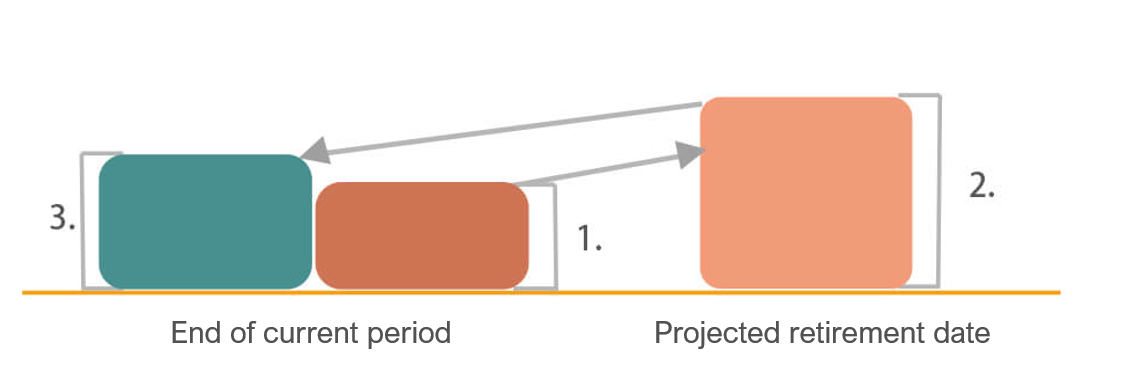
- Determine the amount of benefit built up based on service up to the reporting date in accordance with the plan's benefit calculation formula.
- Calculate the associated cash flows, taking into account factors such as employee turnover, expected salary increases and benefit payment provisions.
- Discount the amount calculated in Step 2 using the discount rate to calculate the DBO at the reporting date.
This approach may look familiar. That's because it is very similar to the Benefit Formula Attribution Method available under Japanese GAAP. Although described using different terminology, both approaches are built on the same underlying principle of attributing benefits in accordance with the plan's benefit formula.
Like Japanese GAAP, IAS 19 also contains provisions relating to materially back-loaded benefit accrual. Where plan rules award a materially large amount of benefit to later years of service, benefits must be attributed on a straight-line basis over the relevant service period.
As mentioned in our first article, the revisions made to Japanese GAAP in 2012 were intended to bring Japanese retirement benefit accounting more in line with international accounting standards. It is therefore not surprising that a broadly equivalent approach was introduced.
3. US GAAP
US GAAP (ASC 715) also uses a benefit approach when measuring defined benefit obligations. As with IFRS, benefits are attributed to periods of service in accordance with the plan's benefit formula and the resulting obligation is discounted to the reporting date.
Under US GAAP (ASC 715), companies are generally required to disclose both the Projected Benefit Obligation (PBO) and the Accumulated Benefit Obligation (ABO).
The PBO reflects expected future salary increases where relevant and therefore is broadly comparable to the obligation measured using the Projected Unit Credit Method under IFRS. By contrast, the ABO excludes future salary increases and reflects benefits accrued based on current salary levels. Comparing the two helps users of the financial statements understand the impact of future expected salary growth on the pension obligation.
For many salary-related plans, the Benefit Formula Attribution Method under Japanese GAAP would satisfy the requirements for measuring the PBO under US GAAP. The ABO could also be derived by removing future salary increases from the calculation.
4. Conclusion
Although the terminology differs, the attribution methods used under Japanese GAAP, IFRS and US GAAP are built on many of the same underlying principles. In particular, the Benefit Formula Attribution Method under Japanese GAAP shares many characteristics with the approaches used to measure obligations under both IFRS and US GAAP.
For companies reporting under multiple accounting standards, it may therefore be possible to adopt an approach that satisfies local Japanese GAAP requirements while also supporting IFRS or US GAAP reporting for group reporting purposes.
Understanding the similarities and differences between these standards can help reduce duplicate work, simplify reporting processes and improve consistency across financial statements.
If you would like to discuss your company's retirement benefit obligations or reporting requirements, please feel free to contact us.